 Solander
How a copy travels intact.
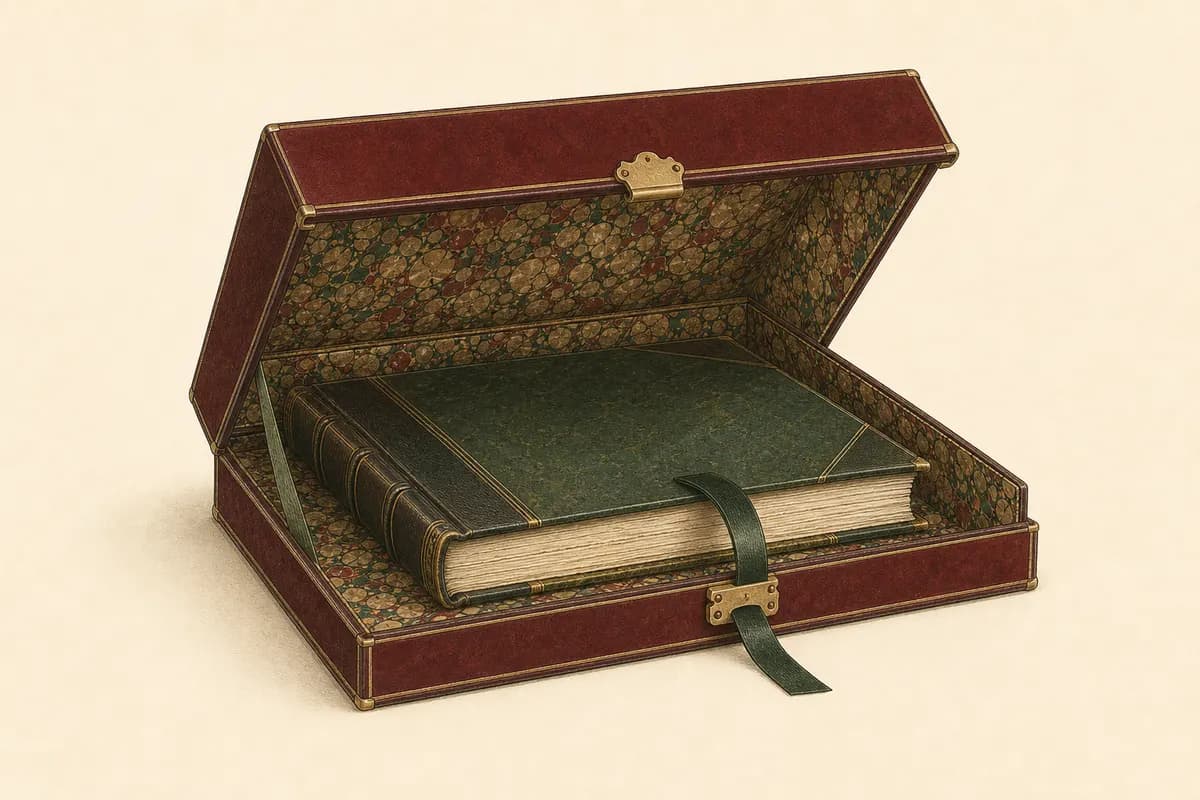
Solander takes its name from the archival box that houses these objects. This is the published doctrine for moving one from collector to collector without harm — numbered, so a seller can follow it and a dispute can be measured against it. The audience has been trained by the publishers on what good looks like; this standard meets that bar.

Principles
- The book and its enclosure are a single fragile object; the enclosure — slipcase or traycase — is the most damage-prone component and the most common downgrade. Pack the whole assembly so nothing moves.
- Never expect the carrier to be careful. Even the gold-standard publisher concedes it cannot guard against mishandling. Pack for the worst.
- Photo evidence is the universal currency of a claim. The pack is not done until it is photographed.
Inner wrap (touches the book)
- Wrap the book first in glassine or unprinted acid-free kraft or archival tissue. Glassine is the conservation choice for valuable copies.
- Never put bubble wrap, tape, or any adhesive directly on a leather, cloth, or vellum binding. Bubbles dent and offset onto the surface; plasticizers mark leather; tape lifts cloth and gilt.
- If bubble wrap is used, it goes over the paper wrap, bubbles facing out — the flat side against the book.
- Moisture barrier: enclose the wrapped book in a sealable poly bag against rain and humidity. Leather and vellum are humidity-sensitive — never leave a parcel in a hot vehicle.
Corner and structural protection
- Cardboard sandwich: rigid corrugated cut to size on both faces of the wrapped book. This stops the number-one failure mode — crushed and bumped corners.
- Corner protectors — foam or rigid board — on hardcovers and on every corner of a slipcase or traycase.
- Immobilise the book inside its own enclosure so it cannot shift within the slipcase or traycase in transit — a common overlooked failure for lettered states in traycases.
Double-box
- Box-in-box. An inner book box, snug, inside an outer shipping box, with at least two inches of firm void fill on all sides so the inner package cannot move at all.
- Void fill is firm only: crumpled kraft, foam planks, or air pillows. No loose packing peanuts against the book — they migrate, hold static, and offer no real protection.
- Slipcase and traycase handling: the cased book is treated as one unit inside the sandwich; the case is never the outermost surface and never bears void-fill pressure directly on a corner.
Labelling and declared value (load-bearing for insurance)
- Never label the box “RARE BOOK,” “COLLECTIBLE,” or otherwise describe the contents. Descriptive labelling that reveals contents voids the insurance claim.
- Declared value is the figure the seller actually settled at — always. No under-declaration, no “gift” marking. Under-declaring triggers an insurer co-insurance penalty (the payout is scaled by declared over actual) and is customs fraud. The proof of value is the seller's own priced record — their PayPal Goods & Services receipt or the carrier's declared-value receipt. Solander never issues an invoice and never holds a sale price, so the seller, who actually settled, is the source of that document — never the platform.
Value-banded requirements
The requirements scale by value, so the standard never punishes a modest reading copy. The bands are the enforceable core.
Under $250
- Required
- Required
- Recommended (USPS $100 auto-included)
- No
- Inner wrap + single sturdy box; sandwich recommended
$250–$500
- Required
- Required
- Required to full value
- No
- Full Standard (S1–S4)
$500–$1,500
- Required
- Required
- Required to full value — USPS declared-value or third-party, not UPS / FedEx alone
- Recommended at $750+
- Full Standard
Over $1,500
- Required
- Required
- Required to full value; third-party insurance strongly steered (carrier collectibles caps)
- Strongly recommended
- Full Standard + double-check enclosure immobilisation
On a Canada Post lane the insurance column reads $1,000 general / $500 collectibles cap— use third-party coverage above $500. Collectible books, including rare books, fall under the collectibles cap, so any collectible copy over $500 CAD on a Canada Post lane must carry third-party insurance; the carrier rail under-insures it.
Signature confirmation is strongly recommended at $750 and above on every lane. (PayPal made signature recommended rather than mandatory for Seller Protection from 26 January 2026 — but on a high-value parcel it is still the seller’s best protection.)
International additions
- Customs honesty is the seller's obligation: the seller declares, on the customs form, the figure they actually settled at — the same figure used for insurance declared value. Only the seller knows it; the platform never knows or stores it. The under-declaration culture of online buy/sell groups is forbidden here — it voids insurance and is customs fraud.
- Never write “RARE BOOK” on the customs declaration or label — the same insurance-voiding rule as on the parcel.
- Printed books are duty-free almost everywhere and are exempt from the US import surcharge — carved out as informational materials. The obligation is not a door fee but a sender-side workflow: the seller completes the carrier's US-bound customs preclearance before shipping. Import VAT or GST may still apply in some destinations, and non-book extras in the parcel may be treated differently.
- Carrier liability caps vary abroad and drive the insurance matrix below. Canada Post's general US and international cap is $1,000, but collectibles — including rare and collectible books — are capped at $500 CAD. Any collectible book over $500 CAD on a Canada Post lane is under-insured on the carrier rail and must use third-party insurance.
- Exotic-skin bindings — crocodile, python, certain lizard — or ivory and tortoiseshell inlay may require CITES permits; standard goatskin, morocco and calf are clean. A self-declaration handles it; the export burden is the seller's.
A seller who ships every copy to this standard earns the Packs to Standard mark on their account. The packed parcel, photographed before it is sealed, is written into the copy’s registry — the seller’s protection and the buyer’s. See how the trust model fits together.